I started the Growth In Reverse newsletter back in December of 2022.
That first edition went out to 4 subscribers (one of which was my own email address). 10 months later, I had 21,000 subscribers.
It all started when I found this one guy making $300k from his newsletter as a solo creator… in his first year.
I had to know how he did it. So I spent 60 hours digging through everything I could find about Mario Gabriele and The Generalist newsletter (podcast episodes, Twitter archives, everything).
I turned it into a 3,800-word deep dive filled with screenshots, graphs, and every data point I could find. And I thought…maybe this should be a newsletter.
Since then, I’ve reverse-engineered 75+ creators the same way and studied thousands more.
The questionable move
All of that to say…I’ve seen a lot of these growth stories. And I’ve talked to even more people who are working through this journey.
When newsletter growth stalls, or people hit a plateau, I see the same thing happen every time.
They go looking for a new tactic. A new way to use LinkedIn, or trying another platform. Maybe this ManyChat thing will kickstart growth again.
But usually, something else is at play, and you probably don’t need a new tactic.
These tactics are just one of 5 pieces of this puzzle that I’ve seen. I walked through all 5 on the Nathan Barry Show, and wanted to share them with you here too.
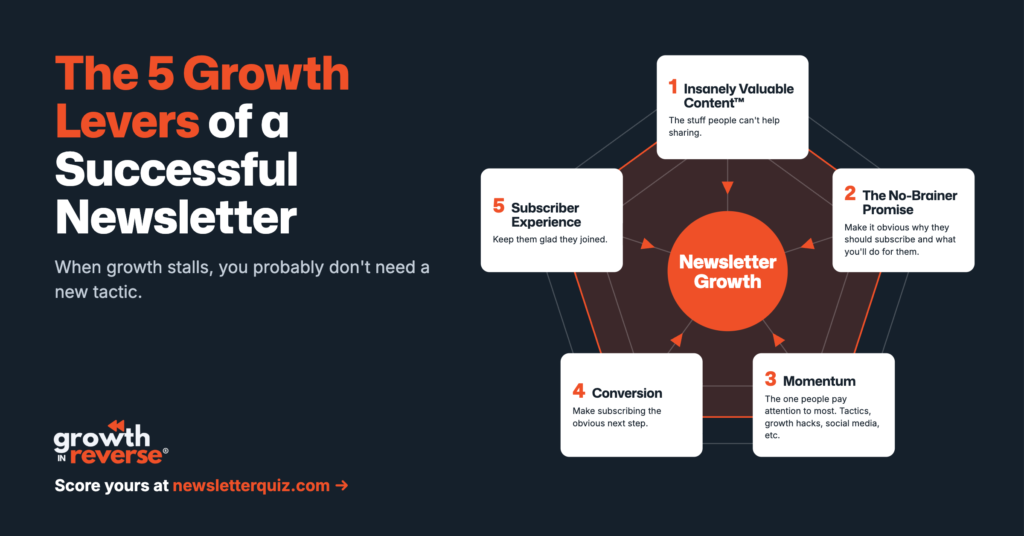
The 5 Growth Levers
Here are the 5, and we’ll go into each one below:
- Insanely Valuable Content™
- The No-Brainer Promise
- Momentum
- Conversion
- Subscriber Experience
These are in this order on purpose, because each one builds on the one before it.
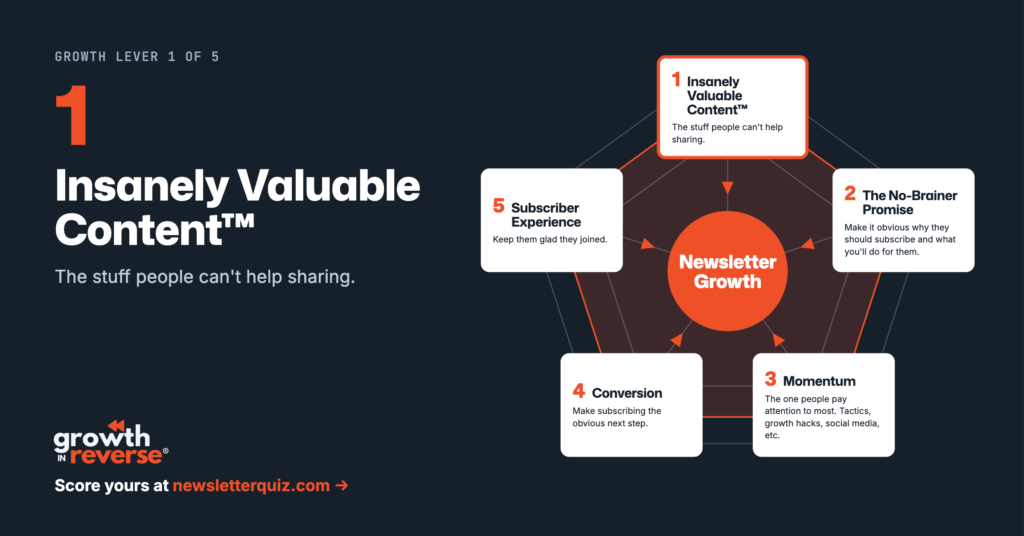
1. Insanely Valuable Content™
Insanely Valuable Content is the stuff that people can’t help sharing with friends. People reply and say, “I cannot believe this is free!”
If you don’t get this growth lever right, everything else is so much harder.
It’s like pushing a boulder up a hill, in the rain, while yelling “everything is fine!”
There are 6 ingredients to an Insanely Valuable newsletter. And all of the successful newsletters I’ve seen combine at least 2 of these, oftentimes 3 or more.
Insanely Valuable content has 6 buckets:
- Helps you make money
- Helps you save money
- Saves you time
- Teaches you something
- Entertains you
- Is timely (speed to market)
Usually, when I talk about this, people think, “I have to write a deep dive,” or this has to be long-form content. Not true at all.
Here’s one example of a much shorter version of this.
Justin Moore from Creator Wizard creates content for people looking to get better at sponsorships and brand deals. His Insanely Valuable content shares brands that are looking to partner with creators right now. Creators can read the newsletter and start making money from his content. Wild!
These emails help people make money, save time, and are very timely (these brands want to work with people now).
Tom Orbach is another great example. He writes the Marketing Ideas newsletter, where each week he shares one quick but tested idea, how it worked, and how you can run it yourself. His readers can walk into a meeting with their boss and pitch a proven idea.
That last part is a big deal. If your reader has a job inside of a company, help make them the smartest person in the room.
How to find your ingredients
Get on calls with 5-10 of your readers and ask them what they need help with, or why they read your newsletter.
Sam Vander Wielen did 1,200 free calls with her customers before launching a product that has since generated over $10 million. She figured out exactly what her customers needed, then built it for them.
The 2 founders of ADHD Weasel got on calls with 300 of their customers. Both completely nailed their content and products because of it.
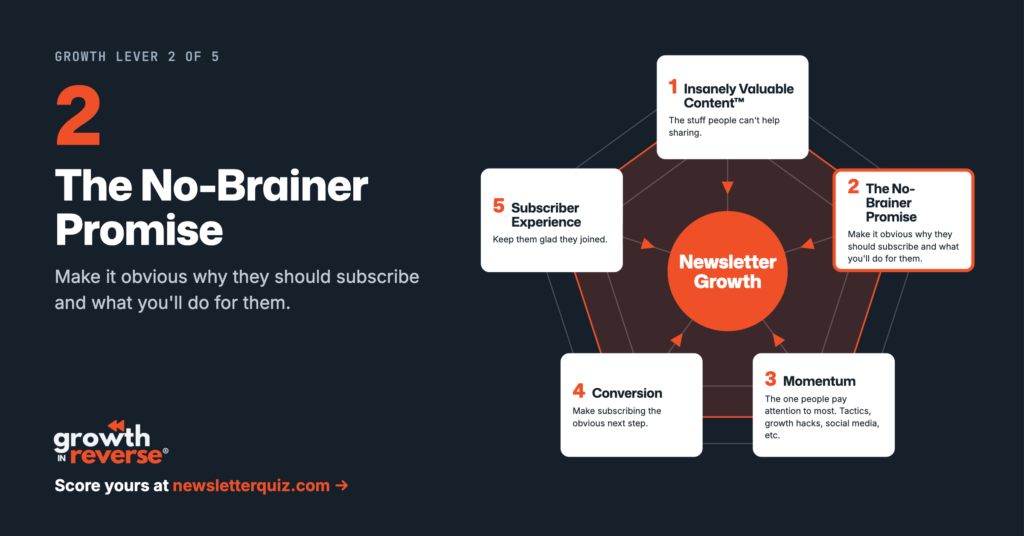
2. Your No-Brainer Promise (i.e. Positioning)
Once the content is Insanely Valuable, you need to let people know what it is and why they should subscribe.
This is a huge piece of the puzzle, because if you have great content but people don’t know what you do, you’ll have a hard time convincing people to sign up.
“Join my free newsletter” or “Get the Wednesday edition” tells me nothing about your content.
Tactically, positioning shows up in small places:
- The headline on your landing page
- Your LinkedIn or Instagram bio
- The first lines of your welcome email
I see creators bury their most interesting piece about their content halfway down the page all the time. Sometimes it’s hiding in the welcome email or on the About page.
Whatever makes you worth reading should be the first thing people see.
Positioning also changes as your newsletter grows and evolves. When you’re just starting, people might know you or subscribe because they saw you on social media. It takes less great copy and positioning to get them to sign up.
Once you hit 50,000 subscribers, you’re reading a much wider mix of people, so this matters even more.
The nice part about an online business is that you can rewrite and test headlines and copy. So while I don’t want you to get too hung up on this in the beginning, it is important over time to keep iterating and try new angles.
Sometimes you don’t even realize why people love your content. So the best thing you can do? Get on calls.
How to get readers on calls
Even if you’re an introvert, this is one of the highest-impact things you can do for your newsletter.
Start with your most engaged readers. Replies are the best signal; clicks are good, but open rates are really unreliable anymore.
Filter your subscribers by how long they’ve been around, or how engaged they are, or both!
I recently sent a plain email to a segment of around 1,300 people, opening up 20 call slots.
They were gone in 7 minutes. So I opened up a few more without announcing it – and those went too. It turns out people love talking to the creators they read and love.
Pro Tip: open and engage with your favorite creators’ content, and you might get included in these segments. 🙂
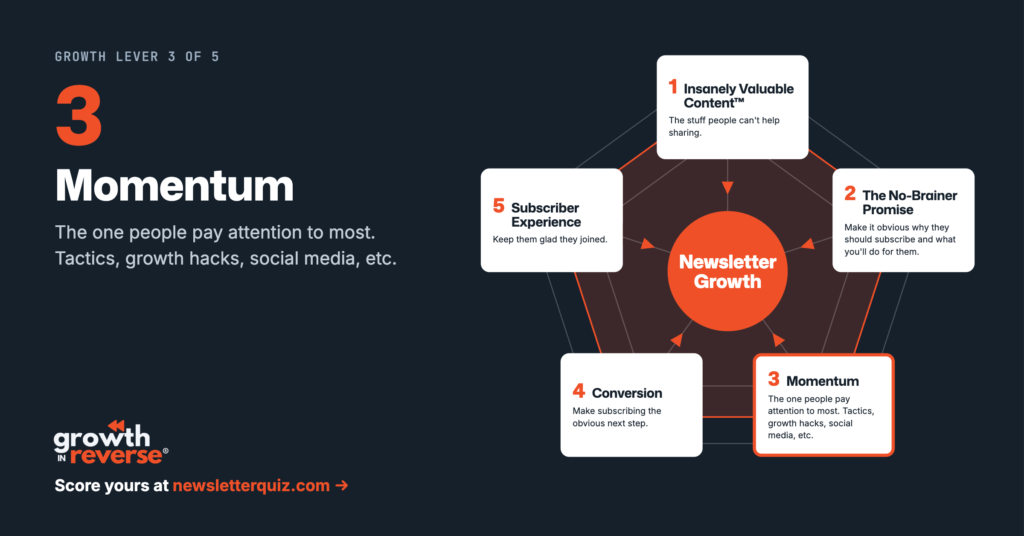
3. Momentum
Momentum what everyone immediately thinks about when they think about newsletter growth. When their newsletter stalls, this is where people go first.
A new growth hack, or some way of getting people to subscribe.
You definitely need momentum, but people spend way too much time here and forget about the other 4 pieces.
The thing here that makes the biggest difference, especially when you’re getting started, is focus.
Pick 1 platform that you enjoy, and you know your customers are on. Try it for 6 months, and if it isn’t working, move on.
People who try to grow on 2-3 platforms at once usually never get good at any of them.
What’s working right now?
Quizzes
Quizzes are one of my favorite distribution plays right now.
I’ve just seen them work really well over and over again.
My friend Charlie had been writing a newsletter about marketing for farmers for 2 years. When she was furloughed from her government job in October 2025, she used her extra time to create a TikTok account about something completely different: how she hit $1 million in net worth by the age of 35.
She hit 58,000 followers in 30 days. 30 days!
I told her to read about Tori Dunlap, whose quiz had been taken over 1 million times (i.e., drove 1 million+ subscribers). So Charlie built a quiz for her newsletter, Building Quiet Wealth. It tells you your best next step towards building your own net worth.
She started promoting that quiz on TikTok and got 1,500 subscribers in 90 days – which doubled her total subscriber count of the newsletter she spent years on.
She’s now over 15,000 email subscribers.
Spoiler alert: I love this one so much I finally built my own to help you with these 5 growth levers.
Repacked Lead Magnets
The other thing that’s working really well? Lead magnets – but in a new form.
Sam Vander Wielen used to do the “comment 152,” and I’ll send you the podcast episode. It worked, but not great.
Now bundles her podcast episodes by topic, for example, all of the ones around building wealth for business owners. She’ll post a video on Instagram and say, “Comment MONEY and I’ll send you the episodes.”
She says it’s added thousands of subscribers to her list.
The best part? She doesn’t have to create anything net-new. She’s just repurposing her existing content into a bundle of episodes.
More Volume
You might not like me after this one. But most of the time when something isn’t working like you’d hoped, it’s because you haven’t done enough of it.
Posting 3x a week? Try posting more.
Writing one newsletter a month? Create more.
The ADHD Weasel guys put out an insane volume of content for a 2-person team. How much is insane?
120 posts per week on Threads. And they recently started doing a similar volume on Substack Notes. 🤯
Every Monday, one of them sits down, writes that week’s posts, and schedules them. Now, they’re not writing 120 newpieces per week, but that level of volume lets them quickly see what’s working and what to repost.
These can come from comments you left on others’ posts that got great engagement, or something you shared in a different format (i.e., a podcast).
It’s okay to tell your best stories more than once.
4. Conversion
Conversion is how you take all of that momentum and turn it into email subscribers or another “owned” audience (podcast listeners, an SMS list, etc.).
We’ve all seen the account with hundreds of thousands of followers and 100 email subscribers. (Or worse, no email list.)
It’s because they don’t tell people they have a newsletter, or their conversion events are non-existent.
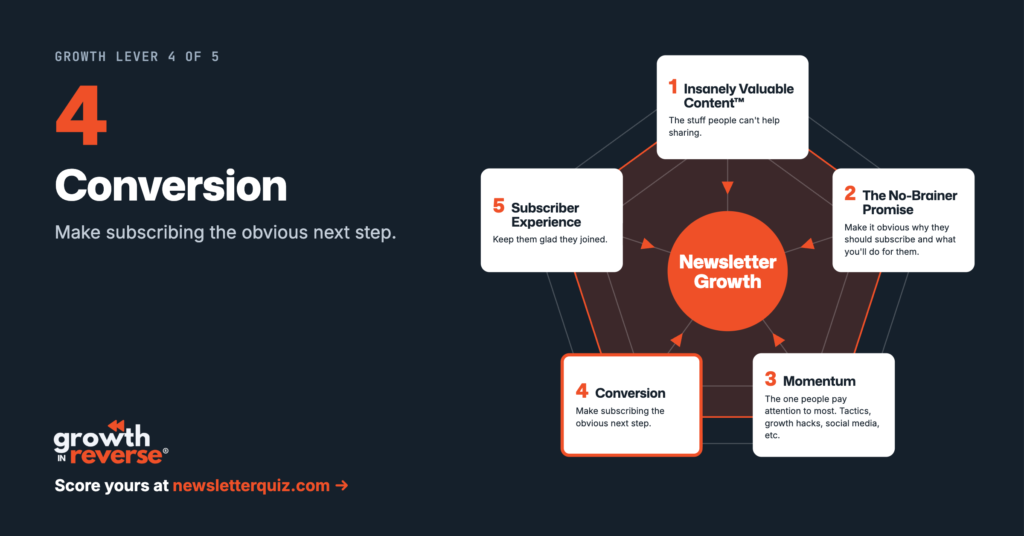
Each step in this journey is a place to improve:
- Impressions
- Clicks to your landing page
- Signups
- Engagement
- Sales
Make subscribing the obvious next step
I’ve done a lot of newsletter audits, and the most common mistake I see?
People tell me that growing their email list is 100% the most important goal they have. And then I go to their social profiles, or their website, and can’t even find a place to subscribe.
Or it’s all the way in the footer, the headline sucks, and there’s no real reason to subscribe (which goes back to positioning, too).
If it is that important, put the subscribe box front and center on your homepage. Add it to your site’s header menu. Put it in all of your social profiles as the main CTA link.
Don’t bury it at the bottom of a LinkTree-style page under 30 affiliate links.
If you sell services, your gut reaction might say that the main CTA should be to book a call. Maybe. But think about how often someone books a call straight from your bio.
I’m a bigger fan of getting them on your email list and letting the emails get them to book a call. Then, even if they don’t, you have more chances to reach them and get in front of them.
Keep iterating the landing page
Dru Riley of Trends.vc saw Dan from TLDR mention that his landing page converted at 40%+.
Dru spent the next year chasing that number. I found 17 versions of his landing page where he was testing all of these.
He rewrote the headline, dropped the name field in the form, added social proof, and kept changing the design until it converted at 40%.
I ended up copying Dru’s layout for my own page, and it converted similarly.
Of course, the layout won’t convert bad traffic, which is why you need to make sure you’re getting the Momentum piece right as well.
5. Subscriber Experience
You ready for the one I see missed most often?
Subscriber Experience is everything that happens after someone subscribes.
“But Chenell, I thought we were talking about growth!”
We are. Have you ever heard someone say that keeping a customer is always cheaper than getting a new customer? The same applies to newsletters and audience growth.
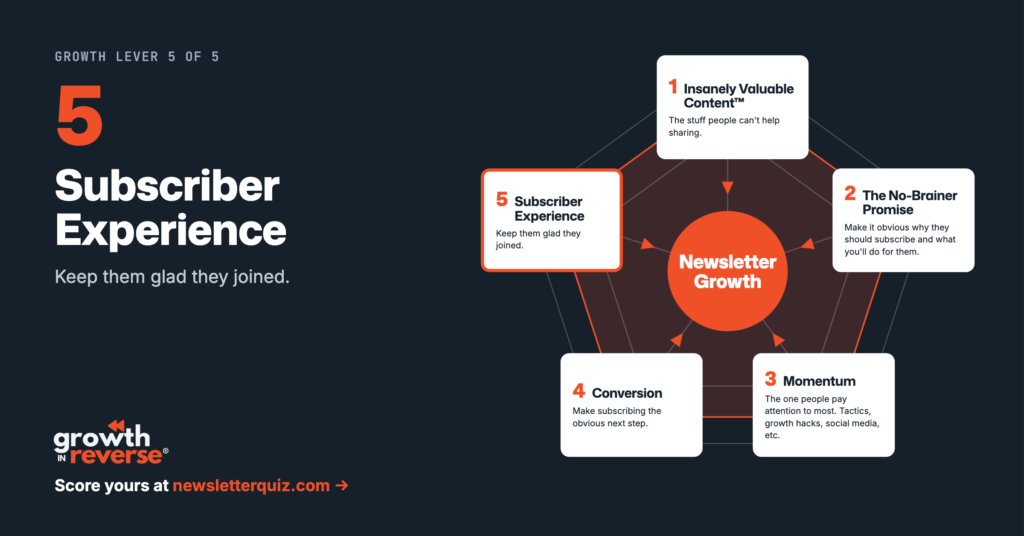
Retention and keeping your current subscribers happy is critical when we’re talking about growth.
Retention is growth.
If you make Insanely Valuable content, position it well, drive the right traffic, and get someone on your list, your job isn’t over. It’s just beginning.
Let them know they made the right decision
I’m a big fan of thinking through your onboarding experience for new subscribers.
The word “experience” is intentional here. What are they seeing, what are you telling them to do next, and how do they stay engaged at that critical moment when they are most excited about your work?
Instead of showing a “Success, you’re subscribed” message, I like to send them to a customized “Almost There page” page that keeps them engaged.
We want them to go to their inbox and open that first email. A “success” message isn’t exactly the most compelling way to do that.
Make the Internet More Fun
As nerdy as it sounds, I think creators can do a better job at making the internet a more fun place.
You can do this in small micro-moments, or in larger ways. Here are a few examples:
- 1440 sends a note from the founders 2 weeks after you subscribe to make sure you’re enjoying the content.
- Katelyn Bourgoin sends a reverse lead magnet – a surprise gift you weren’t expecting.
- James Clear personally replied to every one of his first 10,000 subscribers, a method he learned from Chris Guillebeau, who did this as well.
Being a “small creator” has an advantage here. When you’re only getting 30 subscribers a day, you physically can reply to everyone who joins. As you grow, that gets harder and harder.
This isn’t rocket science. It’s just making the internet, and your ecosystem specifically, a more interesting place.
Secret Shop Your Newsletter
This is one of the easiest pieces of this whole post to implement.
Want to see the experience a new subscriber goes through when they join?
Go subscribe to your own newsletter. See what emails you get, what the pages look like, and moments where you get confused.
Even better? Try it on your phone too. Smaller screens, elements get moved around, etc.
You will be surprised at some small things that can make a difference when you pay attention to this growth lever.
Want to see how you stack up?
Taking some of my own advice in this newsletter, I went ahead and built my own quiz of sorts. It’s called the Growth Levers Scorecard.
You can find it over at newsletterquiz.com.
If you want to hear the full conversation between Nathan Barry and I where we go into each of these 5 even more, you can find it here: