

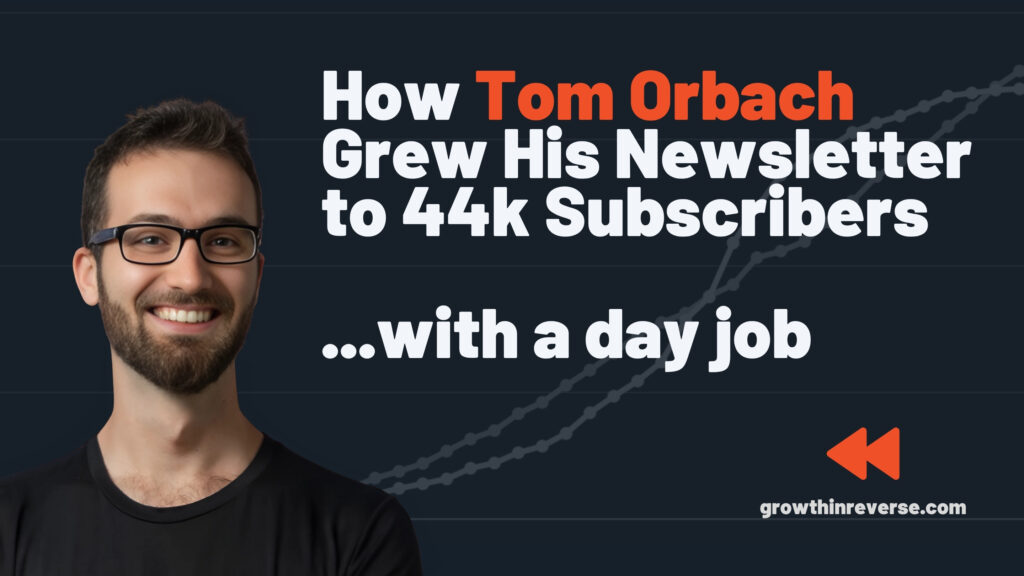
Tom Orbach is the marketer behind Marketing Ideas, a weekly newsletter that exploded from zero to 44,000+ readers in less than two years.
In mid-2025, Tom successfully launched a paid tier for his newsletter, pulling in over $50,000 in the first 72 hours from 500+ subscribers.
And he did it all with a full-time job.
From Viral Side-Project to Newsletter Creator
Tom has been known for his creative marketing ideas since before he launched his newsletter. In 2022, he built a parody tool called the “Viral Post Generator” that let users auto-generate cringey LinkedIn posts – it went mega-viral and had over 2 million users!
It was then acquired by Taplio just one week after its launch. Insanity.
Tom used the funds from that sale to purchase the premium domain MarketingIdeas.com – a “very expensive” dot-com he felt would make his project instantly credible as the category king of marketing ideas.
Tom didn’t know what Marketing Ideas would turn into, whether a blog or resource, but he knew people were hungry for marketing ideas. He eventually decided on a newsletter in 2023, and the rest is history 🙂 Just kidding, the rest is below for you to dig into.
This article comes from a conversation Dylan and I had with Tom. You can watch the full thing over on YouTube.
Building the Waitlist Before the Product
After he bought the domain, he started plugging a simple waitlist at every event and conference he spoke at.
Every time he got on stage, he’d mention MarketingIdeas.com and tell people to join the waitlist – without even explaining what it would become.
“I started speaking in conferences and being a panelist or keynote speaker, and every time I plugged it and told people to join the waitlist of MarketingIdeas.com without knowing what it’s going to be in the future.”
By the time he launched in August 2023, he had 1,000 people ready to read his first email.
“I had like a thousand people that got my first email, which is amazing because when you start with zero and you just send out emails, no one reads them. It feels really bad.”
Starting with an audience instead of zero subscribers gave him the momentum and feedback he needed to keep going.
The One-Day-Per-Week Strategy
Here’s what might surprise you: Tom built a 44,000-subscriber newsletter while working full-time as Director of Growth Marketing at a cloud security company.
His secret? Extreme time constraints.
“I work Monday to Friday, and then on Saturdays I write the newsletter. I dedicate one day per week, the Saturday, for the newsletter and that’s it. I think if I had more than one day, I would have just stretched it to forever.”
But here’s the important part – while he only physically writes on Saturdays, he’s constantly collecting ideas throughout the week.
“I physically write the newsletter one day a week, but I think about the newsletter and try to grow it every single waking moment, every time I’m breathing and not asleep.”
His full-time job actually became his content laboratory. As a marketing director, he could test tactics and strategies during the week, then write about the successful ones on Saturday.
“Without my full-time job, I would have never succeeded in my newsletter because all of those experiments and the marketing ideas and the tactics and strategies that I come up with and send people every Friday, I do all of those myself in the full-time job that I have.”
Tom’s 3 Growth Levers
Tom grew from 1,000 to 44,000 subscribers using three main channels:
1. The LinkedIn Content Lottery
For Tom, LinkedIn isn’t about a perfectly crafted post, but more about showing up often enough to win attention.
He was posting daily, and many of his posts are just short descriptions of a single marketing idea with a screenshot from the newsletter.
“I just write a lot of content there. Some of my posts are snippets of those marketing ideas with a single screenshot from the article, and then if you want more, head over to MarketingIdeas.com to read more.”

Sometimes those posts flop. But the ones that land bring waves of new subscribers, and the volume gives him more chances to win.
He treats LinkedIn like a slot machine where he controls the number of pulls. His feed is filled with examples of marketing creativity, reverse-engineered campaigns, and frameworks anyone can apply.
“Every time I click the post button on LinkedIn, it’s like getting a lottery ticket. Some of them hit, some of them don’t.”
Unlike other creators who keep their best content behind a paywall, Tom gives away high-quality ideas in public. That’s how he builds trust. His LinkedIn account became a lead-gen channel because the content itself was worth following, not because it was used as a teaser.
And when something resonates, he doesn’t let the moment go to waste. He turns high-performing posts into Substack Notes as well.
2. Substack’s Built-in Growth
Tom credits two Substack-native features with significant, ongoing subscriber growth: Notes and Recommendations.
With Substack Notes, he posts short, tweet-style updates directly on the platform. These often get picked up by the Notes algorithm and shown to readers of related newsletters.
Substack shows exactly how many subscribers each note drives, so Tom can see which topics resonate and which ones don’t. Over time, he’s leaned into the themes that lead to subscriber spikes.

But the biggest and steadiest source has been recommendations. He approached this differently than most.
Instead of cold-DMing other writers asking for swaps, he offered value first—writing full guest posts for more established newsletters. Not just shoutouts, full articles. Some of his best content, published on someone else’s list.
Once those posts performed well, the other writers took notice. Some started recommending him automatically because they saw traffic coming from Tom’s direction (thanks to his own Product Hunt and LinkedIn visibility).
Others did it as part of a mutual exchange, building long-term partnerships instead of one-off swaps.
Recommendations gave him a constant trickle of new subscribers. Not spiky growth, but steady – and unlike social posts, they don’t decay in 48 hours.
“With Substack recommendations, it’s always alive. I always get new subscribers from those recommendations. It’s a fantastic growth lever.”
3. Product Hunt Launch
Tom studied Product Hunt extensively, learning all of the ins and outs.
He built relationships with active Product Hunt users. He looked at launch timing, image formatting, headline styles, and copy structure.

Product Hunt is a hub for tech professionals, startup founders, and indie hackers. They were the perfect fit for a newsletter offering bite-sized marketing tactics and frameworks. Tom knew this well, and made sure he positioned his product exactly for the Product Hunt audience.
And when he finally launched there – his newsletter hit #1 Product of the Day, #1 of the Week, and #1 of the Month. That exposure alone led to more than 7,000 new subscribers.
That one launch carried compounding benefits. People who discovered him on launch day kept sharing future issues. His Substack metrics got a bump, and other creators started recommending him based on the exposure.
“You need to be thoughtful and mindful about whatever you do. You need to actually care about it in order to succeed.”
The 2-Year Trust Building Phase
For almost two years, Tom never monetized. No sponsorships, no affiliate links, no products. Just pure value every Friday.
I thought he was a little crazy, but it worked.
“I wanted to build trust with my audience. I wanted them to really enjoy the free content, and it worked when I flipped the switch.”
This decision was crucial to his later success. When he finally launched paid subscriptions, people trusted him completely because he’d never tried to sell them anything before.
The Surprise Drop
Unlike most launch strategies that recommend weeks of teasing, Tom kept his paid launch completely secret.
“No one knew before, except for 10 friends who helped me with advice. I just dropped the bomb one Wednesday morning.”
I pushed back a little and mentioned how other people would have teased it beforehand, and he agreed it might have helped, but honestly? His launch nailed it, so I’m not sure he needed to tweak anything.
The 9-Day Email Sequence
Tom created a manual email sequence (since Substack doesn’t have automation) that he planned in an Excel sheet:
Day 1 (Wednesday): Long launch email with social proof and 24-hour discounted pricing
Day 1 (Evening): Reminder with added value, not just “don’t forget”
Day 2: Sale extension due to Stripe issues, another reminder
Day 3 (Friday): Book launch (more on this below)
Day 4 (Saturday): FAQ about the book
Day 5 (Sunday): First chapter of book free, subscribe to read more
Day 6 (Monday): Social proof from new paid subscribers
Day 7 (Tuesday): Smaller sale, ending Friday
Day 8 (Wednesday): Another reminder
Day 9 (Friday): Campaign ends
Not every email went to everyone. Some reminders only went to his 2,000 most engaged subscribers to avoid unsubscribe fatigue.
The Book Strategy
On top of launching a paid newsletter, Tom decided to also launch an entire book at the same time: we’re talking a 400+ page, full color, behemoth of marketing ideas called “Marketing Moonshots.”
Tom didn’t launch everything at once. He saved the book announcement for Friday of launch week, creating a second wave of excitement.
The book was crucial because it made the offer “non-calculatable” – people couldn’t just think “$20 for 4 emails per month = $5 per email.”
“I don’t want people to make those comparisons. The book is one of them, and the community that I’m starting in the newsletter for the marketing leaders that are paying is also part of it.”
I love this whole idea of making his product non-calculatable. Such a smart way to move people past the “well each email is worth $5” decision each month their renewal is coming up.
The Launch Results
His paid newsletter launch exceeded all expectations:
- 500+ paid subscribers in the first few days
- All 500 subscribed before receiving a single paid email (pure trust-based purchasing)
- 30 days later, almost no one had canceled despite many joining just for the book
- Revenue of $50,000+ in the first month
The email that converted best? The first day’s reminder email with 10 hours left on the sale. Urgency works.
What’s in the Paid Tier?
Tom’s paid subscription includes:
- Premium marketing ideas he’d been saving for two years
- Archive access to all past content
- Free PDF copy of his 400-page book
- Community access (launching September 2025)
- Career growth advice once per month instead of marketing ideas
The career content was strategic – it gives him content variety while ensuring he doesn’t run out of marketing ideas (though he’s already planned through 2026), which I’m super jealous of! 🙂
The Unexpected Algorithmic Boost
Something interesting happened after Tom launched paid subscriptions: his free growth accelerated.
“My growth rate for free subscriptions and actually for the paid too, the natural growth rate that I used to experience, it’s like it’s doubled now.”
Tom’s theory? Substack makes money when creators make money, so they boost paid newsletter creators in their algorithm.
“Think about Substack. What do they want? They want to make more money. How do they make money when I make more money? So they want me to make more money. So they send more subscribers my way.”
Challenges of Going Paid
Not everything was smooth. Tom faced some unexpected negativity from subscribers who felt “betrayed” by the paid launch.
“There are some people that will never pay for any newsletter, not mine and not other newsletters, and they feel really betrayed. They started sending me really aggressive emails like ‘what are you doing?’ They used really hard words and I wasn’t prepared for it.”
His advice? Expect this reaction and don’t take it personally. People are used to free content, and some will never accept the transition to paid.
6 Key Lessons for Newsletter Creators
Coming away from this conversation, there are a number of lessons I see standing out here:
1. Build Trust Before You Sell
Tom spent two years giving away his best content for free. When he finally asked for money, people trusted him completely.
2. Your Day Job Can Be Your Laboratory
Instead of seeing his full-time job as a constraint, Tom used it as a testing ground for newsletter content.
3. Time Constraints Force Focus
Writing only on Saturdays prevented endless perfectionism and forced Tom to ship consistently.
4. Make Offers Non-Calculatable
Don’t just sell “4 emails for $20.” Add books, communities, and other elements that make the value harder to calculate.
5. Plan Your Launch Like a Campaign
Tom’s 9-day sequence wasn’t random. Each email had a specific purpose and built on the previous one.
6. Start Building an Audience Before You Know What You’re Building
Tom collected email addresses before he even decided to do a newsletter. Build the audience, then figure out what to give them.
What’s Next for Tom
Tom isn’t stopping at newsletters. His plan includes “micro launches” every few months:
- The community launch in September
- Additional books and resources
- New benefits for paid subscribers
Each micro launch gets a full campaign treatment, keeping things interesting for both Tom and his audience. And makes the whole thing even more “non-calculatable.”
For creators considering a paid newsletter, Tom’s story shows it’s possible to build a substantial business. But it requires patience, consistency, and a genuine commitment to serving your audience before serving yourself.
I can’t wait to chat with him again in the future and see how he’s built his strategy to regularly bring in paid subscribers, vs the big launch.