

Being a guest on the right podcasts built a small list that quietly generates 7-figures.
Welcome to Day 3 of the 30 Days of Growth.
This is a pop-up newsletter put together by the team at Growth In Reverse. We’ve pulled 30 creators together to help give one short, actionable way you can either grow or improve your email list.
You can view past issues here.
There’s a version of list-building that looks like a numbers game. Run more ads, post more on LinkedIn, hope the algorithm likes you today.
And it works, kind of.
But the subscribers you pull in that way might not ever get to know you.
So what’s the alternative?
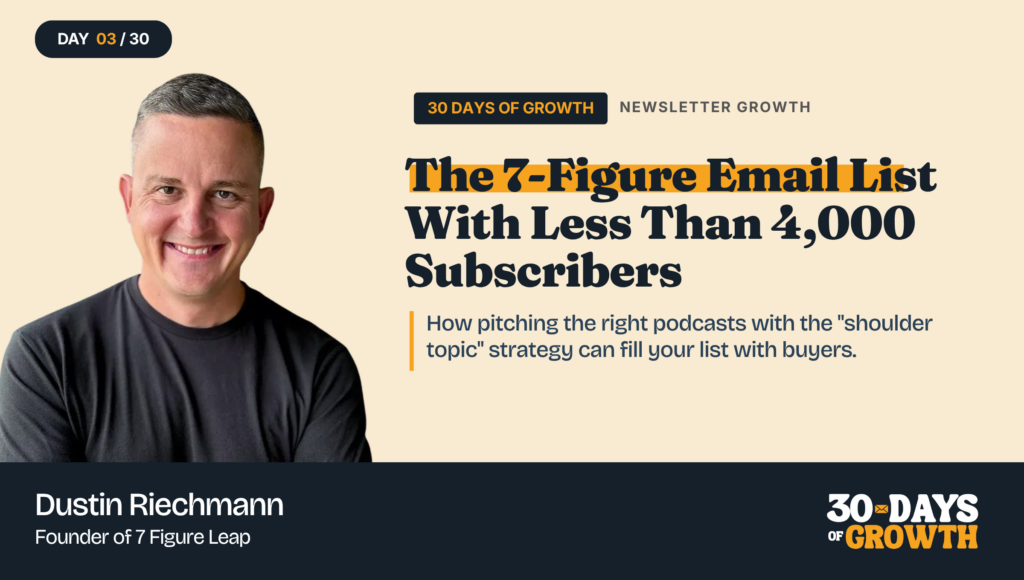
Dustin Riechmann has a small email list under 4,000 subscribers, that generates about 7-figures per year.
He did that through a very specific approach to podcast guesting. One that brings in subscribers who are already warm before they ever hit your opt-in page.
Almost every subscriber came from a long-form podcast interview. By the time someone hits his welcome email, they’ve already spent 45-60 minutes listening to him talk about the thing he’s an expert in.
They’re basically a warm lead right away.
How Dustin Does It
Well, Dustin made podcasting his entire growth strategy. And that focus by itself is useful, but here is how he finds the right podcasts to get on.
1. He targets “shoulder topic” podcasts instead of direct competitors. Rather than guesting on shows that cover his exact niche, Dustin looks for podcasts serving an adjacent audience. People who’d benefit from his expertise but aren’t already drowning in information about it.
For example, if you’re a relationship coach, you don’t pitch other relationship podcasts where the host already covers your exact lane. You pitch a podcast for first-time parents (who are stressed and need communication help), or a personal finance show (where couples fight about money).
2. He looks for a content gap to fill for that host. The host gets an episode they couldn’t have recorded themselves, which makes Dustin easier to book. His new subscribers show up already seeing him as the specialized expert on that topic.
3. He screens podcasts against 3 basic criteria before pitching:
- The show has to do guest interviews
- It has to have published something in the last 30 days
- It has to clear a size bar (usually 100+ ratings on Apple Podcasts)
4. He uses the interview itself to warm the subscriber. A long-form podcast conversation builds real trust over 30 to 60 minutes. By the time a listener hits Dustin’s landing page, they’re far more likely to know, like, and trust him.
Why It Works
Podcast listeners are a different kind of audience. They’ve chosen to spend an hour with a guest. That’s a level of attention you really can’t buy with an ad.
The “shoulder topic” angle matters because it positions you as a specialist in a room full of generalists. On a direct-competitor show, you’re 1 of 50 similar guests the audience has heard. On a shoulder show, you’re the only person in that lane, which makes you memorable and makes the host want to have you back.
The result is a subscriber who self-selected. They heard your story, liked it, and went out of their way to sign up. That is an incredibly warm subscriber. And it’s a very different quality of subscriber from someone who clicked ‘Subscribe’ on a recommendation widget.
Results
- 4,000 total email subscribers on the list
- Average of $285 revenue per subscriber per year which is roughly 5x to 10x what most creators see
- 7 figures in annual revenue from that small-but-engaged audience
- Subscribers arrive pre-warmed, which has downstream effects on open rates, click rates, and conversions
How You Can Implement It
Step 1: Pick 2-3 shoulder topics adjacent to what you teach. Write down the audience you’d serve on each one.
Step 2: Build a list of 20-30 podcasts in those shoulder topics. Use the 3 filters: guest interviews, updated in the last 30 days, 100+ Apple Podcasts ratings.
Step 3: Write a short pitch that names the content gap you fill. Tell the host what their audience would get from having you on that they can’t get from the host alone.
Step 4: Set up a dedicated landing page for each podcast, or at least for your top few. A URL like yoursite.com/[podcast-name] works great.
Step 5: Drop your CTA into the interview where it comes naturally. Tie it to something you discussed on the show so it feels like part of the conversation.
Step 6: Track subscribers by source so you know which shows actually convert.
Tools
- A simple spreadsheet or
Notion database to track target shows - Listen Notes for research
- A landing page builder (Carrd, Kit, your website) for episode-specific opt-ins
Dustin’s list is probably a lot smaller than the general perception of a “successful” newsletter’s audience. But the quality of those subscribers is so high that the math works out completely differently.
A small list of people who genuinely trust you is worth more than a big list of people who barely remember signing up.
See you tomorrow,
Chenell
P.S. Dustin runs 7-Figure Leap where he helps experts grow their business through podcast guesting. Grab Dustin’s The Premium Podcast Guesting Playbook.