How one question leads to 100s of replies and a content calendar that practically writes itself.
Welcome to Day 14 of the 30 Days of Growth.
This is a pop-up newsletter put together by the team at Growth In Reverse. We’ve pulled 30 creators together to help give one short, actionable way you can either grow or improve your email list.
You can view past issues here.
As your list grows, sometimes the engagement metrics steadily decline. Justin Welsh saw the same thing happening.
His open rate was stuck around 51% (which is still better than most), but he knew something was off. So he tried something super simple, but wildly effective.
At the bottom of every Saturday essay, he started asking readers 1 open-ended question. Something conversational, tied to whatever he just wrote about.
“What’s holding you back from X?” or “What would you add to this?” The kind of thing you can answer in 2 sentences without thinking too hard.
Sounds simple, right? But I couldn’t believe the results.
Every week he started getting 300 to 500 replies, his open rate climbed from 51% to 61% over the next few months. And referrals jumped more than 20%.
How Justin Did It
1. He asks 1 question, every single week. It sits at the very end of the essay, right where you’d normally put a sign-off. The question is always open-ended and always tied to the topic of the essay.
Here’s a recent one:
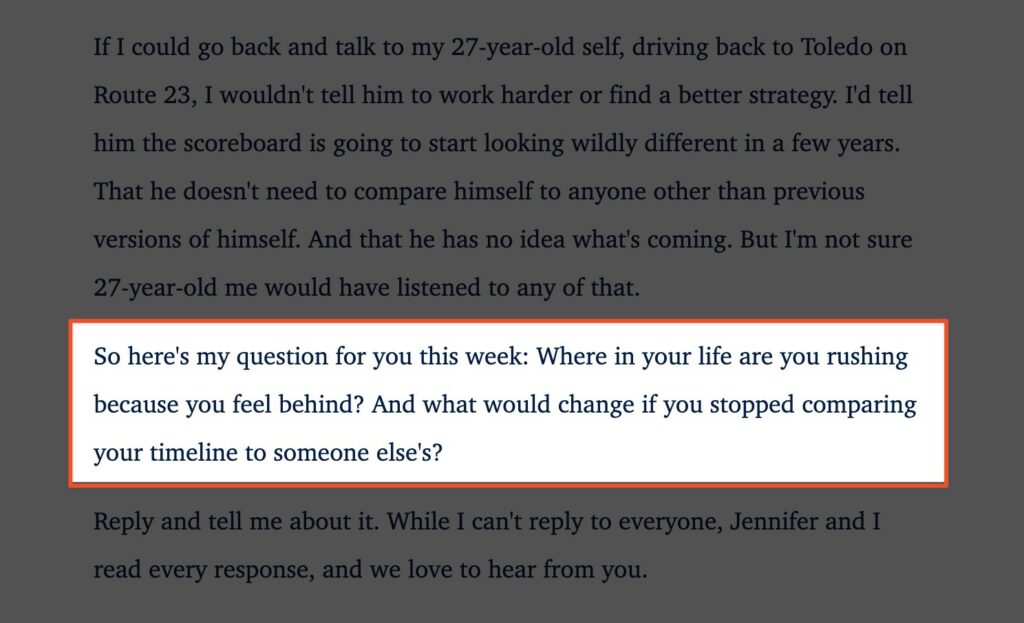
2. He wants free-form text replies. Justin’s going after specific language (aka voice of customer research). He wants to see how his readers actually describe their problems in their own words, with all the weird phrases and hedges and half-rants, the stuff you can’t get from a multiple choice question.
3. He has Claude help him bucket the responses into themes. Reading 300-500 replies by hand every week is basically a part-time job, and I don’t know any creator with that kind of time. So Justin has Claude help him curate recurring themes, and surfaces the questions his audience keeps asking.
What used to be unscalable is now maybe an hour on a Saturday afternoon.
4. He writes the next essay straight from the themes. This is the part I love. Justin’s editorial calendar is basically whatever his readers told him they’re stuck on this week. His audience is writing the newsletter with him, they just don’t know it.
Or maybe they do now 🙂
Why It Works
Relevance is everything in email. When a reader sees your subject line and feels “oh, this is for me,” they open.
Email feedback loops can be slow. You send something, stare at the open rate 2 days later, guess at why it went up or down, and tell yourself a story.
Justin’s loop is way tighter. He asks, they answer, he writes, they open. It compounds weekly, and the metrics move with it (which is probably where the 20% referral bump is hiding too, because engaged readers share Insanely Valuable Content).
The AI piece is what makes it hold at scale. You can probably read 20 replies a week and categorize them in your head. 500 would break you. Justin’s AI setup scales with his list instead of buckling under it.
Results
- Open rate climbed from 51% to 61% – which at 175k subscribers is an extra 17,500 people opening the email 🤯
- Referrals are up more than 20%
- 300-500 free-form replies per week as a steady content input – which has downstream effects of helping deliverability, etc.
How You Can Implement It
Step 1: Add an open-ended question at the end of your next edition. Keep it conversational and tied to the topic. You’re going for a reply, not survey data.
Step 2: Put the question somewhere visible. Last paragraph of the body, not buried in a footer.
Step 3: Read as many of the replies as possible. You’re listening for language and emotion – for the phrases people keep repeating.
Step 4: Keep a running doc of themes. When the same topic shows up from 3 different readers, that’s probably your next essay.
Step 5: Once the reply volume gets unmanageable, have Claude or ChatGPT help by surfacing themes for you.
Step 6: Write your next essay directly from the replies. Quote readers where you can (with permission). They’ll spot themselves in it, and that’s where the referrals start.
Tools
- Your inbox
- Claude or ChatGPT to pull themes at scale
- A simple Notion page or Google Doc to log recurring themes for your editorial calendar
Writing about what your readers want sounds obvious. The hard part is knowing what they actually want, in their own words, every week. Justin broke that problem down to one question.
When your writing lines up with what your audience cares about, open rates go up, referrals go up, and growth stops feeling like you’re pushing a boulder uphill.
See you tomorrow,
Chenell
P.S. You can follow Justin on LinkedIn, or subscribe to The Saturday Solopreneur at justinwelsh.me.