

Sean Griffey and his 2 co-founders, Eli and Ryan, built Industry Dive in 2012.
It started as 3 guys in an abandoned convenience store, using leftover IKEA desks.
After 8 years, they built the business up to a $100M+ exit with 500 employees across the globe.
Sean recently joined us on the Growth in Reverse podcast to break down exactly how they did it.
And spoiler alert: it wasn’t quick, it wasn’t easy, and it definitely wasn’t what most newsletter creators are doing today.
Let’s dive in. (pun intended)
Forget 1 Newsletter. Why Not Start With 5?
Most people launching a newsletter would start with one, perfect it, then launch a second. And keep building that way.
But Sean and his co-founders did something wildly different.
They launched 5 daily newsletters on day one, all covering completely different industries. 🤯
I had to ask him why, because that just seemed a little crazy:
“There are a lot of people that say, ‘I’m gonna do this one and when I perfect it, I’ll do the second.’ And then you wake up and it’s been 10 years and you’re still on the first because none of them are ever perfect.”
Yep, I can understand the reasoning there.
If you want to build a $100 million business (which was their explicit goal from day one), and do it with small niche audiences, you kind of have to build a bunch of them.
But “The hard part when you launch with 5 is they all suck,” Sean said.
Starting with 5 was a great forcing function for them to get better, fast.
And since they were just 3 guys with a few freelancers, their days from the start looked something like this:
The morning routine: Write and send newsletters.
The afternoon routine: Figure out how to grow the business.
That was the schedule for the first 3 years.
The Moment They Knew It Was Working
Success didn’t come fast.
Sean is “really impressed and jealous” of creators today who monetize in six months and grow to 100,000 subscribers right away.
That wasn’t their experience at all. It took a full year before things started clicking.
But then came the moment Sean knew they had something real, something worth dedicating the next decade to.
One day, the published a story they got really wrong. It was about Duke Power, a utility company in North Carolina. Within 15 minutes of sending the newsletter, Duke Power’s PR team called to tell them, in so many words, what idiots they were.
Sean thought, “This is really bad…..but this also means we matter.”
If a major corporation was tracking them down within 15 minutes of them hitting send, important people were reading. And they cared. They knew they were building staying power.
Newsletter Growth via LinkedIn Groups
When we asked Sean about early growth tactics, he laughed and said, “The secret of audience development is you’ve got to be in like 20 channels all the time because what works today is not going to work tomorrow.”
And one tactic worked incredibly well in 2012-2015? LinkedIn groups.
Back in 2008, during the recession, Sean said unemployed people were creating LinkedIn groups hoping to network their way into jobs. Groups like “Retail Industry Professionals” or “Healthcare Executives.”
By 2012, some of these groups had 200,000+ members and they weren’t being monetized at all.
Industry Dive would go in and buy these groups from the creators.
Why? Well these were super targeted groups of professionals in those industries. And LinkedIn had an incredible feature that let you send one email per week to every member of that group.
They started sending those emails asking people to subscribe to the Industry Drive newsletter in that particular space.
And it worked brilliantly.
The Calendar Reminder They Never Missed
You could send those emails once every 7 days. But it was exactly 7 days from sending one email to being able to send the next.
Sean remembers sitting at his computer waiting for 11:00am to hit. Then they’d send it at 11:01 the next week, 11:02 the week after that. He didn’t want to miss that timeframe, because over time if they missed it by even an hour, they would eventually lose a whole day.
And when you’re relying on that to help grow your audience, that’s not a risk you want to take.
LinkedIn Groups in 2025
Sadly, LinkedIn shut down that feature so this isn’t as big of an opportunity today.
But of course, I did have to dig in and see if they were still using LinkedIn Groups in 2025. And I was surprised to see they are still quite active with these groups.
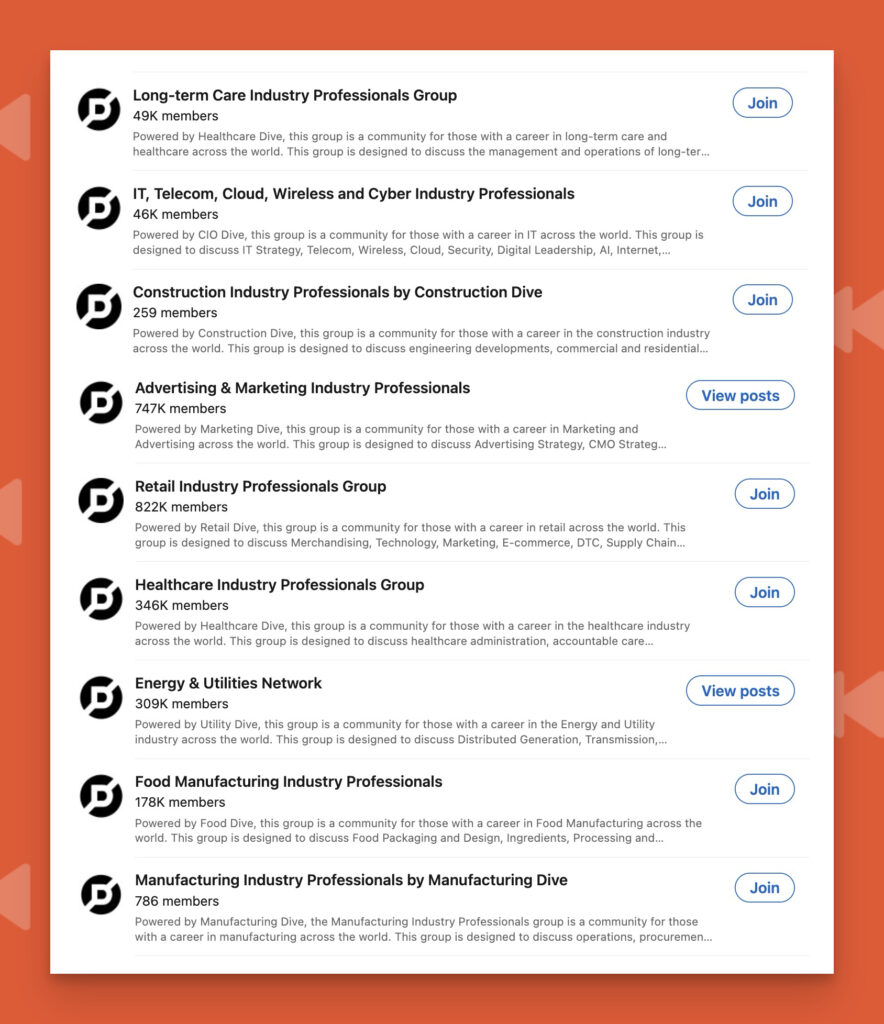
Today, Industry Dive has about 70 LinkedIn groups and posts content in them, but it doesn’t drive results like it used to.
These days they seem to be using a pinned post strategy in the groups. Every month or so, the admin will share a link to that specific Industry Dive newsletter with a link to join.
They pin the post at the top of the group so all new and existing members see it when they visit:
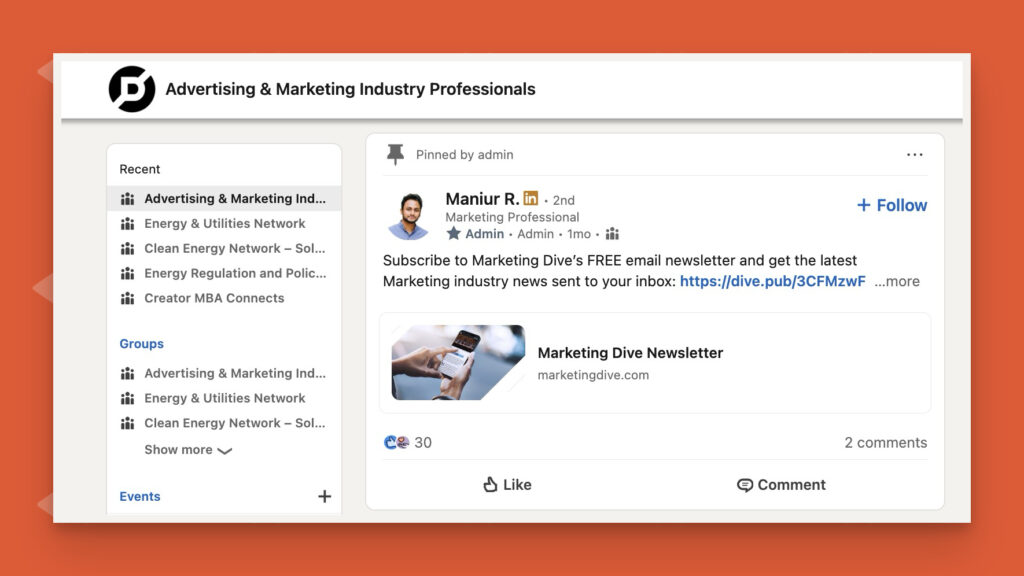
You can tell the engagement is nowhere near what it used to be when LinkedIn Groups first launched. But that’s the point. These things work until they don’t, and then you have to find another arbitrage opportunity.
Sean’s point stands: you need to be experimenting across multiple channels because what works evolves over time. But once you find something, go hard until it stops working.
Personal Emails to Every Subscriber
Through my research, I’ve come to see that as people grow they stop doing some of the initial “unscalable things” they did in the early days. Those super impactful, high touch strategies that you can’t really do as the business grows.
But those don’t get talked about as much, and everyone seems to be chasing the super scalable things you can do. So I had to ask Sean about this and see if he had a hidden unscalable strategy.
I wasn’t shocked to hear that the answer was “yes.”
Sean emailed every single subscriber personally, asking how they were doing, what they could improve upon, etc.
“I wanted people to realize there’s people behind this and that it’s not a corporation sending marketing material. There’s real humans in there.”
He’d spend hours going back and forth. He wanted people to reply—but secretly hoped they wouldn’t reply a second time because he was drowning in emails.
What came from those conversations?
- Stories and angles they were missing. Industry Dive was writing for people with lots of industry expertise. The team wasn’t as deep an expert as their readers were, and this feedback showed them what they were missing and where their takes were naive.
- Trust and sharing. People started rooting for them and sharing the newsletters with colleagues.
- Real partnerships and money. Some conversations led to new audiences or even sponsorships and brand deals.
People would say, “I’ll promote your newsletter if you do this small thing for me.” Suddenly, they’d hit a growth curve.
Having people root for you and share your work changes everything. And it’s also why pouring more time and energy into making your content more Insanely Valuable is so key.
What About Paid Growth?
Industry Dive raised a family and friends round of money when they initially got started, but other than that, they were bootstrapped.
They didn’t have massive budgets for paid acquisition. So they relied more heavily on organic channels. When we asked him how much they spent on paid growth Sean said they’d spend maybe $500 to $1,000 a month on ads.
“But that was big money back at the time when you didn’t have any money.”
Even as they scaled, Sean knew that organic needs to be the biggest channel if they wanted a real, long-term audience that feels connected to their brand. People who come via paid just aren’t as sticky or bought in.
Thus, their commitment to spending time on lots of organic channels to find one that could reliably bring in readers.
Monetization: 100% Marketing-Supported
“I always fear that there’s a lot of people that say if I create good content and draw an audience, the rest will take care of itself. And it doesn’t. You have to think about monetization at the exact same time as you think about who am I writing for and what content’s going to resonate.”
All three have to work together: content, audience, and monetization.
From day one, Industry Dive was what Sean calls “marketing-supported,” which is essentially sponsorships and brand deals.
And because they were great sales, in the early days their revenue opportunities outpaced the size of their audience. They couldn’t serve all the advertisers’ demand because their lists weren’t big enough yet.
“We couldn’t serve all of the demand our advertisers had for putting their content in front of our audience because the audience wasn’t big enough.”
But they didn’t just give up, they got creative with monetization.
Here are just a few of the interesting ways they are able to monetize their newsletter.
The Co-Registration Play
On the thank you page after someone subscribes, Industry Dive shows 3 sponsored options you can sign up for as well, including playbooks and webinars.
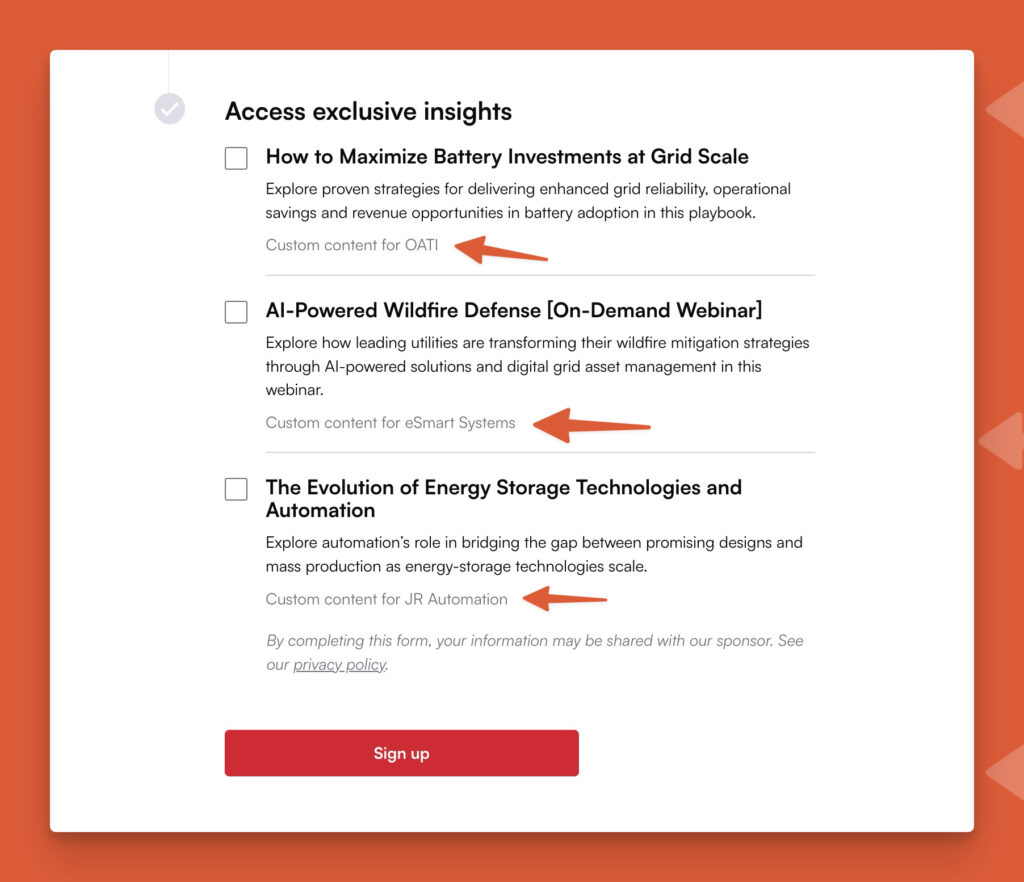
New subscribers can opt into these reports, which generate leads for sponsors immediately, before the subscriber even gets their first newsletter.
Trendlines: The Micro-Site Strategy
I dug in and asked Sean what were some of the more interesting strategies they’ve used that he thinks other creators could do as well. He mentioned Trendlines, and this sponsored option might be their most underrated product.
The editorial team identifies the five biggest trends they’re covering in a given industry. For example, in Retail Dive, they have one called “Inside employee financial wellness strategies.”
Then they create gated micro-sites around each trend, sponsored by individual brands. Each micro-site aggregates all of Industry Dive’s existing editorial content about that trend, maybe six articles that tell the full story, and it gets updated every couple months.

This one is sponsored by HealthEquity, and here is why this is a win-win-win strategy:
- Readers get the biggest trends in that industry, organized and updated regularly. They genuinely want this information.
- Advertisers get to sponsor content around a very specific trend that their solution addresses. If you’re a payroll software company, you can sponsor the Trendline about payroll compliance trends.
- Industry Dive is reusing content they’ve already created. Zero additional editorial work beyond organization and curating these into a custom playbook of sorts. And these playbooks drive additional subscribers, who then are raising their hand and showing ID what they are interested in.
You can’t really get much more aligned than that.
The Content Studio: 35-40% of Revenue
As Industry Dive scaled, they realized their customers (marketers) had problems beyond just reaching their audience:
- They had complex stories to tell and weren’t great at telling them
- They’d generate leads but didn’t know how to nurture relationships
So Industry Dive built a Content Studio to help solve those problems.
They’d create custom newsletters for brands, full publications with websites, and video. They’ll create social campaigns – pretty much anything to help marketers connect with their audiences.
Sean said the studio probably represents 35-40% of total revenue.
The lines blur because many campaigns bundle everything: “We’ll create a marketing strategy for you, create content, distribute that content, and use our first-party data on your customers to inform everything.”
So the lines are fuzzy in terms of actual money brought in, but this feels like a huge play I don’t see a ton of big media brands doing well.
Their North Star Metric
With all the sophisticated analytics available, what did Sean and his team obsess over?
Engaged subscribers with the right job titles.
That’s it. That’s the North Star.
They’d build filters in their analytics: “Here are the job titles we care about in this industry. Are they engaged with our stories?”
Sometimes one of their stories would go viral on Reddit. Which sounds like a dream for a newsletter operator. But they would actually turn off their ads if that happened, because Reddit traffic wasn’t who their advertisers wanted to reach. Generic traffic would give advertisers a negative ROI.
Sean cared about three things:
- Is the email list growing?
- Are people engaged?
- Are the RIGHT people engaged?
Opens, clicks, event registrations, content downloads – those are what mattered. But only if it was the right audience.
The Bot Traffic Problem
Sean is militant about filtering out bot traffic to ensure advertisers reach real humans, not machines.
“People tell me they have a 70% open rate and these click rates. I’m like, I just don’t believe you. I don’t believe you understand what’s happening to your newsletter.”
Fifteen years ago, email didn’t have much bot traffic. Today, it’s everywhere.
If you email business domains, spam filtering devices go through your emails immediately—opening them, clicking every link. It registers as engagement when it’s not.
Some people are naive and don’t realize it’s happening. Others know but think their clients (i.e. sponsors) aren’t smart enough to notice.
Sean’s philosophy: “I’m going to serve the smartest client that actually knows what’s happening and be proud of the results we say we’re getting.”
Because if you’re not driving real results for advertisers, it doesn’t matter if you claim 100% open rates. Nobody who clicked through converted or took action.
Those sponsors are not going to stick with you for the long run, so you’re playing a losing game there.
The Future of Newsletters
After 20+ years in newsletters and digital media, Sean just stepped away from the day-to-day at Industry Dive earlier this year.
So what does he see coming next?
He’s incredibly bullish on newsletters. He says that none of the reasons newsletters were great 20 years ago have disappeared. There are only new reasons why they’re great now.
The technology is easier. Tools are better. You’re not fighting to build mobile-optimized templates anymore (that was hard in 2012).
But the fundamentals – why newsletters connect with audiences, and why they’re valuable – have only gotten better.
AI tools level the playing field. Sean thinks this is an incredible time to start something because “it feels like the snow globe’s being shaken and everyone’s on the same footing.”
What he thinks is the next frontier: helping audiences connect with each other.
But Sean thinks 10 years from now, we’ll look back at someone who built community differently and changed the game.
It took eight years of daily newsletters, constant experimentation, obsessive focus on the right metrics, and genuinely caring about serving their audience and advertisers well.
That’s what led to their large $100 million exit.
The opportunities are still there.
The tools are better than ever.
But the real question is: are you willing to put in the work?
Listen to the full conversation with Sean Griffey on the Growth in Reverse podcast.