30 days of emails became a new lead magnet and kept new subscribers extremely engaged
Welcome to Day 28 of the 30 Days of Growth.
This is a pop-up newsletter put together by Chenell from Growth In Reverse. I’ve pulled 30 creators together to help give one short, actionable way you can either grow or improve your email list.
You can view all past issues of the 30 Days of Growth here.
A lead magnet gets downloaded and forgotten. A series gets people to actually show up.
Jess Campbell built a 30-day challenge for nonprofit professionals. Each day, participants got 1 email with 1 actionable step they could take to grow their nonprofit’s email list.
30 days, 30 steps, 30 emails.
Sounds familiar, eh? 🙂
Jess saw me run 30 Days of Growth last year and wanted to do something similar for her niche, and it worked!
737 people signed up. About 60% of them were brand new to her list, so roughly 440 new subscribers from a single campaign.
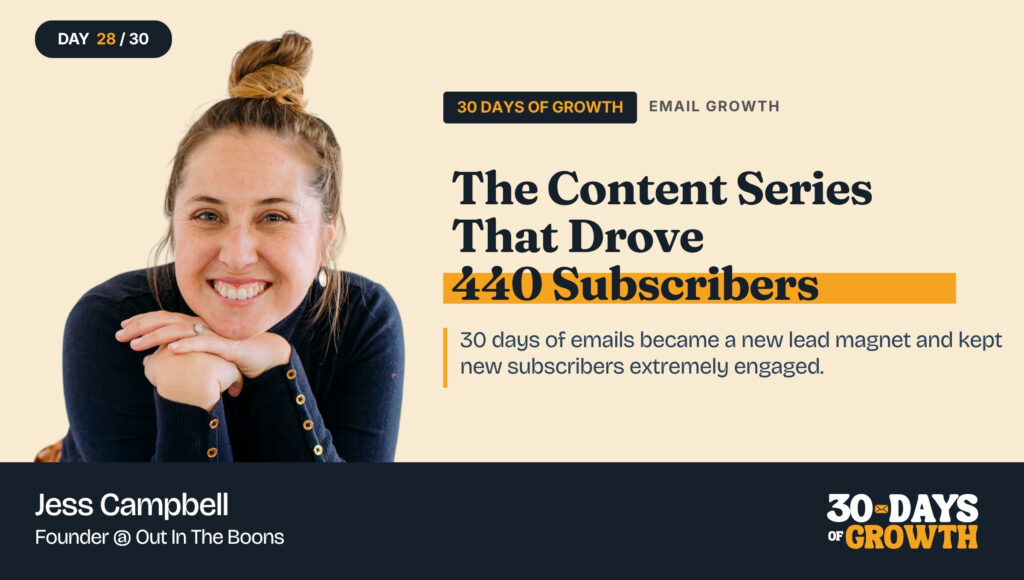
Jess expected to hate sending daily emails. She didn’t. And now she’s planning to flip the whole thing to evergreen and run ads to it.
How Jess Did It
She picked a topic her audience was already asking about (nonprofit list growth) and broke it into 30 daily actions. Each email gave participants 1 thing to do that day. Small enough to knock out in a single sitting.
For promotion, she sent 5 emails to her existing list of about 5,000 subscribers over the lead-up period. She also posted about the challenge on LinkedIn 7 times to her 19,000 followers. Her employee Mackenzie posted about it once, and that one went viral (which probably helped with the 60% new subscriber number).
She set up a simple opt-in page and redirected new signups to a short TypeForm survey right after registration. 73% of people completed it, which gave her useful audience data. She learned that 74% of her audience had fewer than 5,000 subscribers on their nonprofit’s list. That kind of insight shapes everything she builds next.
The daily cadence did something she didn’t expect: it trained subscribers to look for her name in their inbox every morning. 65.9% average opens across 30 consecutive sends is hard to pull off, and it sends a strong signal to email providers that people actually want her emails. That has downstream effects on deliverability for everything she sends after the challenge wraps.
Why It Works
A challenge comes with a built-in timeline. When someone signs up, they’re committing to 30 days. That’s a different level of buy-in than downloading a PDF and telling yourself you’ll read it later (you won’t).
By day 10, opening Jess’s email became a habit. By day 30, her name is probably one of the most recognized in their inbox. It’s hard to build that kind of familiarity with a weekly email.
The best part is now that the content is already written, she can run paid ads to the landing page and let it run on autopilot. She basically built a lead magnet that keeps working for a full month.
Results
- 737 signups, ~60% new to her list (roughly 440 new subscribers from 1 campaign)
- 65.9% average open rate and 14.2% CTR across 30 daily emails
- Fewer than 20 unsubscribes over 30 days (under 3% churn)
- 73% survey completion rate on the post-signup redirect
How You Can Implement It
Step 1: Pick a topic your audience is already curious about and break it into 30 daily actions. Each one should be small enough to do in a single sitting.
Step 2: Build a simple opt-in page. Jess used Flodesk, but any landing page builder works.
Step 3: Promote to your existing list first. Jess sent 5 emails during the lead-up. If you have a team member or collaborator who can post about it on social, even better.
Step 4: Post about it on whatever platform your audience uses. Jess posted 7 times on LinkedIn. Repetition matters here because people rarely act on the first mention.
Step 5: Send the emails daily for 30 days. Keep each one focused on 1 action. Jess said building the “press send” muscle ended up being a good exercise, even though she expected to hate it.
Step 6: After the challenge ends, consider flipping it to evergreen. The emails are already written, the opt-in page already exists. Add paid ads if you want to keep it running on autopilot.
Tools
- A landing page builder (Flodesk, Kit, etc.) for the opt-in
- Your ESP for the 30-day email sequence
- LinkedIn or your social platform of choice for promotion
Jess built a 30-day challenge, promoted it with a few emails and some LinkedIn posts, and walked away with 440+ new subscribers. The content is already written. The next step is evergreen. That’s a lead magnet with a 30-day shelf life that keeps renewing itself.
See you tomorrow,
Chenell
P.S. You can follow Jess on LinkedIn, or check out Out in the Boons.