How Tyler Cook used 7 emails to pull replies, train inboxes, and filter for engaged subscribers.
Welcome to Day 16 of the 30 Days of Growth.
This is a pop-up newsletter put together by the team at Growth In Reverse. We’ve pulled 30 creators together to help give one short, actionable way you can either grow or improve your email list.
You can view past issues here.
Did you know that the first few emails you send your new subscriber are the ones the inbox algorithms pay the most attention to?
Whether they engage with your welcome sequence or not really matters. Their actions (or lack of) can impact things for every email you send them.
Fortunately, there’s a way to improve this experience for you and your new subscribers.
Tyler Cook is a deliverability expert running Hypermedia Marketing. Tyler gets called in when clients’ sender reputations are already in trouble.
One of his clients had a 300k email list…but it was sitting at sub-40% inbox placement before Tyler took over. That means only 40 out of every 100 inboxes received his clients’ emails.
Not good.
Tyler rebuilt the client’s welcome flow around a 7-email sequence designed to pull replies, train inbox algorithms, and filter out the people who weren’t going to engage anyway.
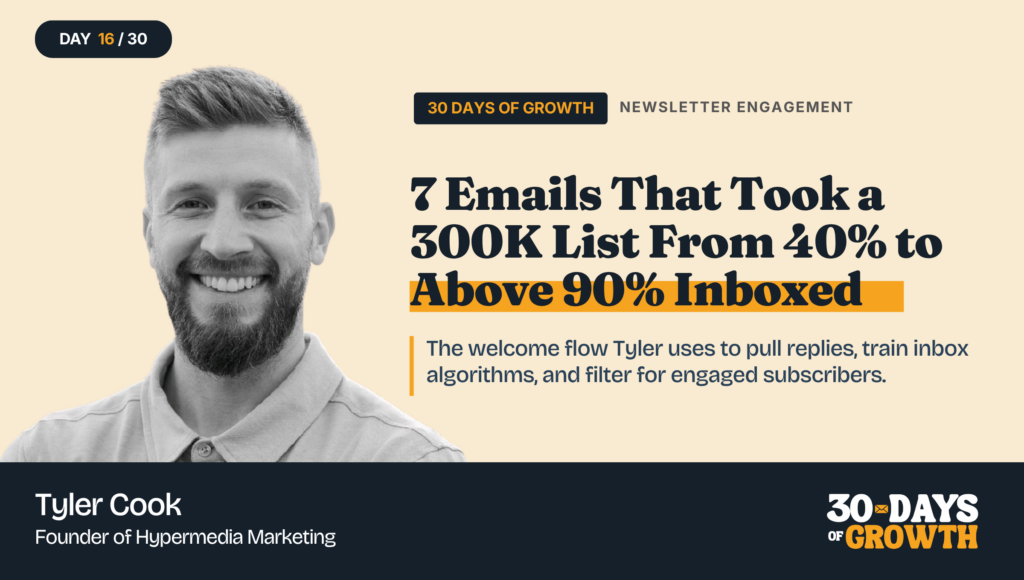
The result: deliverability climbed from sub-40% to above 90% (as reported through GlockApps.)
How Tyler Does It
Email 1 gets sent from someone who isn’t the founder. The first email is under 100 words, signed by an executive assistant or someone who isn’t the C-suite. The whole point is to guarantee inbox placement and pull a reply as fast as possible.
Note: a reply auto-adds your email address as a contact in Gmail and Yahoo, which basically whitelists you forever.
Email 2 is the actual welcome email. By the time Email 2 arrives, Email 1 has already pattern-interrupted the typical onboarding sequence. That means engagement on the welcome (Email 2) itself tends to be higher than usual.
Email 3 pulls subscribers onto a second channel. Email 3 introduces a secondary channel (ex. LinkedIn, Instagram, or Twitter).
Email 4 is a new subscriber survey. He asks for content topics they want, where they found him, and who else they follow. That last question is the gold (aka voice of customer research). If a bunch of subs follow the same person, that’s where his next acquisition push goes.
He bookends the flow with referral asks at Emails 5 and 7. The first one captures subscribers at peak engagement, shortly after they’ve opted in.
Email 6 is the scary one. It’s a prompt to unsubscribe: “you’ve gotten 5 emails, you know what we talk about, here’s the unsubscribe link if this isn’t for you.” Some people will leave. The ones who stay become significantly more invested.
Email 7 is another referral ask. This ask is sharper, often tied to a real incentive like a raffle or gift card, and it lands harder because Email 6 just filtered for the most committed subscribers.
Why It Works
Inbox algorithms treat the first week of a subscription like a probation period. Replies, contact-adds, opens, and clicks during this window weigh more than the same signals 3 months in. The 7 emails are basically engineered to generate those signals in compressed time.
The unsubscribe prompt is the surprising one. Subs who stick around after being explicitly invited to leave are telling you they want the content. They open more and complain (mark as spam) less.
The survey converts strangers into something closer to readers. People who answer 3 questions about their interests have already invested 30 seconds, and they engage more with whatever comes next.
Results
- A 300k client list went from sub-40% inbox placement to above 90% reported through a tool called GlockApps
If you’re paying attention, you remember voice of customer research from both Justin’s end-of-email question and Sam’s video reply.
How You Can Implement It
Step 1: Add an Email 1 sent from a non-founder or more “casual” address with a single question that prompts a reply. Keep it under 100 words. The goal is a real human reply that lands in your inbox.
Step 2: Move your existing welcome email to Email 2. The pattern interrupt from Email 1 makes engagement on this one stronger.
Step 3: Add a “follow me here” email at Email 3 that pushes subs onto a secondary channel. Pick the platform you actually post on and spend the most time on.
Step 4: Build a short subscriber survey for Email 4. Ask 3 to 5 questions, including “who else do you follow on this topic?”
Step 5: Add a referral request for Email 5 and an even sharper, incentivized one for Email 7. The early ask captures peak engagement. The later one captures the most committed subs.
Step 6: Add an honest unsubscribe prompt for Email 6. Make it sincere. The people who stay are worth more than the ones who would have ghosted later.
Tools
- Your ESP (that has email sequence functionality)
- mxtoolbox.com to confirm your SPF, DKIM, and DMARC are set up first
- GlockApps or Inbox Monster to see where your emails actually land
- Tally or Typeform for the subscriber survey
The first week of a subscription is the strongest signal you’ll ever send to an inbox provider about your relationship with a new reader. A polite welcome email kind of wastes that window, whereas a 7-email flow built around replies, surveys, and an honest unsubscribe ask is how you build a list that’s still engaging a year down the road.
See you tomorrow,
Chenell
P.S. You can follow Tyler on LinkedIn, or learn more about Hypermedia Marketing at hypermediamarketing.net.